 The
variety and quantity of wildlife here is staggering. Many of the species
are endemic to the island including the waved albatross, the Española
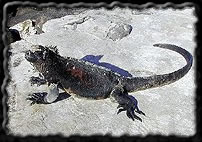
Mockingbird, the Española marine iguana, and the giant Lava Lizard.
 Starting
with the rocky landing, you'll be greeted by territorial sea lions who
usually need to be herded out of the way to make room for the pangas.
The path up to the island is full of marine iguanas basking in the sun.
Watch your step for the many lava lizards that run quickly across your path.
The trail cuts across the island to the rocky cliffs
on the other side. About half way in you'll see the waved albatross (from
April to December). Some nest right next to the path, others, right on it.
The birds have no fear of visitors and you can get quite close without
disturbing them. On the far side of the island is the only place where
these birds nest. It is estimated that there are 10,000 to 12,000 pairs
of albatrosses on Española and that these are the only ones of
this species on the planet.
When you get to the cliffs, the view is breathtaking.
The waves work their way under the rocky volcanic rocks through a blow
hole forming a salt water geyser that spurts every couple of minutes to
create a spray of mist that fills the coastline. Here  you'll
see swallow-tailed gulls and red-billed tropicbirds.
On the path back you'll encounter many blue-footed and masked boobies who mate and nest here. The mating rituals of these birds is both beautiful and entertaining as they dance, sing and bear gifts for their potential partners.
Other birds found at Punta Suarez are the Galapagos hawk and Darwin finches.
The tour of Punta Suarez takes about 2 hours. The landing is wet, so bring the appropriate shoes. Bring lots of film because you'll use it all.